Ways to Cut Costs at a Healthcare Facility

There are several ways in which you can cut the costs and spending at your healthcare facility. If you take care of your hospital and your employees, then they will take care of you in return. This is what I mean: investing in solar panels in sunny areas and reducing the amount of light and light bulbs being used and instead replacing with windows or other sources that can produce natural light on its own. Not only will this give a homey feel but also it will cut back on the electricity cost of the hospital.

Now taking a different turn, investing in employment health and disease preventions. If we take the time to make sure our employees are well vaccinated, properly tested for the current diseases and common flus whether they are natural to our habitat or whether it may come from a different country. We need these types of answers and we need it answered for all the employees so that our patients and their safety are not being compromised. This is majority of the reason why hospitals have not only started to implement proper hygiene but also constant washing of hands or sanitizing surfaces that come in contact with patients a lot throughout the day.

Staying on the topic of employees, another great way to cut cost that not everyone feels comfortable talking about is taking a second look on overtime pay. Although a very controversial topic, if management paid a spec of attention to what positions are actually need rather than what are wanted, they can significantly reduce costs and avoid over hiring people and then not understanding why there is such high turnover rate. As for overtime pay however, this ties in to the previous post which suggests that employers need to take another good look at the schedule and really determine who is needed and who is not. This can save everyone time, energy, and money especially for company so large.

In addition, if a healthcare facility takes the initiative to improve the quality of care given to patients, believe it or not, this can actually reduce the costs of the hospital’s total spending. Think of it like an investment, it might seem like a lot at first but once the hospital gets in the groove of how this system works, it’ll be all worth it in the end. Improving patient care quality and service is actually a payout on its own because of how much everyone gets used to the customs and greetings of the hospital.

Recycling is also a great initiative to take to improve the health and up-keep of the hospital. Whats amazing about recycling is that it can be done in many different ways and can also be delegated to different departments who can be responsible for it that week or month. And to keep it engaging and interesting, it can be turned into friendly competitions amongst departments and such to increase interest amongst the faculty so everyone can engage in recycling. The faculty also needs to realize that there is more to recycling than just saving the planet, it can make your own facility self sufficient or very close to it if these processes are practiced.


HFMA Webinar: Conquer the Top Five Workforce Management Challenges

In this webinar, I learned about the 5 challenges that we will take a closer look at right now. To start off, this webinar was conducted by 3 different people who are either managers, directors, or executives. Challenge 1 is called Flexing Staff Based on Volumes and Patient Needs which mainly just discussed how hospital and healthcare facilities need to schedule their employees on a daily basis based on patient needs and attendance everyday at the hospital. For example, if the manager knows that Mondays and Fridays are very busy for the hospital or at least for their department, it is up to them to make sure there are enough employees so that patient care and quality of service is not compromised. Another important aspect that Gina mentioned in the webinar, is that if these fluctuation timings are already expected and prepared for, then it will cause less disruption and disturbance in the work flow of the department which will increase employee satisfaction, patient satisfaction and of course the monetary benefits. This will ensure that not every employee is staying back to help out and in turn getting overtime because the manager or lead overlooked the schedule and doesn’t have enough coverage.

Challenge 2: Managing Overtime and Premium Labor Costs was mostly about how managers and department leads can manage their workers accidental overtime when they are not scheduled. Gina gave a great example that there was a facility who was able to reduce their employees’ missed lunches by 35% by sending out just one email to the staff and having a meeting and addressing the situation. Many of the workers were missing or had to miss lunch because they were understaffed and did not get to eat a proper meal. This is one of the reasons as to why staffing properly based on patient and hospital needs is so important.

Challenge 3: Leveraging Staff Across the Enterprise is actually a very smart challenge to face and accomplish because not only is scheduling important for the staff to ensure that you have enough coverage but also being able to efficiently spreading them out across the department while utilizing them is and can be very beneficial. For example, if you have certain employees who have different strengths then this challenge can serve as being able to resourcefully use the employees you have in the correct discretion. Certain employees can and should be placed in specific areas and assigned certain tasks that you know they will be able to complete in a timely manner or in the time necessary for you. Of course, we would not go off of convenience for the employees who can be more beneficial and resourceful in another location of the hospital compared to another.

Challenge 4: Moving from Retrospective to Proactive Productivity teaches us here that instead of analyzing the accomplishments after the shift is over or after the pay period is over might be too late. For example, if something needs to be evaluated but was only conducted for one day then waiting 2 weeks to analyze the results from that scenario seems bizarre to me. This challenge is suggesting that managers, leads, or directors need to start doing evaluations and analyses during the shifts so as to better delegate the work load amongst the employees. This will increase efficiency and communication between the staff and the patients.

Challenge 5: Managing Turnover can be a bit of a hassle because this in my opinion, all depends on leadership and management. It is up to the management to make the conscious decision on who they choose to hire and how many people they choose to hire. For example, of course all depending on your job description that you are trying to fill, you would need to hire someone who matches that description to the best of their ability. So if you have a clerk position that needs flexibility and someone who can stay in that role for about a year or more, then a high school student who is about to graduate who is looking for a summer job will obviously not be a good candidate. This being said, I truly believe the managers and directors have all the control when it comes to high turnover rates. If you keep your people happy, they will keep you happy. That means that if you fulfill their needs, requests (within reason), and make them feel appreciated, then they will definitely stay in their current position which will decrease your rates of turnovers.

Women in Leadership Roles

In general, women have been excelling in every field in leadership positions and roles for the past few decades. In recent years, it has become more common and apparent; the direction of thinking has changed for several  people when conversing about a woman in a leadership role.

The other day, when I was scrolling passively on LinkedIn, I noticed an article that was talking about a new CEO being named for Memorial Hermann. When I looked deeper into the article, I found that not only a woman, but a young asian woman had been named the Senior Vice President and CEO of Memorial Hermann Southwest and Sugar Land Hospital locations. I was in shock that this happened and that there was an article about it to promote the news to everyone in the community. The reason I was so shocked was because you don’t see many articles about women in leadership roles or their success stories, they are usually about men who have been promoted or who have received an award. This really caught my attention because of the publicity this news article is getting not only just on LinkedIn but also other social media sites like Facebook, Twitter, etc.

Her name is Malisha Patel and she earned her bachelors degree in biological sciences from UT Austin and her MHA from Trinity. Along with the education, she has been the recipient for many distinguished awards and has been recognized for leading many high stress operations and strategical planning for the Memorial Hermann system. The work she has done is incredible and definitely deserves to be a CEO. As a leader of healthcare, as a successful woman, as a fellow asian, and as a young and aspiring health citizen leader, she inspires me to go great lengths in my education and my drive to assist the healthcare community by applying my best self in this field of work. It makes me feel extremely proud of the community that I am a part of that allows women of my kind to excel and be the best they can be in their field. This also gives me hope and guidance on which direction to carve my career path in so that I too have the opportunity to one day become a Chief Executive Officer just like Ms. Patel.

The reason why I mention Ms. Patel’s promotion and achievement in this blog, this extensively, is because I want every woman out there to understand and accept that we are all capable of achieving this kind of success. I do not want any women to ever limit themselves or think that “enough is enough” or that they have pushed through far enough and will not be able to get ahead. This is not the right attitude and it definitely was not Ms. Patel’s attitude, otherwise she would not be where she is today.

As we can see, times are changing every day. Before it used to be the norm that a CEO would have to be a man and only men could give and order executive and final decisions on high-risk tasks. Since that is not the case anymore, people have started to understand that women can be managers, directors, and CEO’s as well because what they say also goes. Through this journey, we need to continue to support each other because as women, we are still growing. And we will continue to grow because of the ample amount of education, opportunities, and risks we are being provided and tested with.

Women will continue to always be leaders and it is my hope that we will show we can do even greater things than we’ve already done. But one day, we will reach the point where we will have a woman serve as the President of the United States of America.


DIA2em9V0AAT8mU.jpg

Sources:

  1. http://www.fortbendstar.com/memorial-hermann-hospitals-name-new-ceo-patel-promoted-as-haralson-takes-med-center-post/
  2. https://twitter.com/the_nwc_tweets/status/900779827728453633 (picture)


Healthcare Leadership & Management: The Foundation of a Harmonious Hospital

When a patient enters the main gate, they want to feel safe and secure. That they are in great hands and that the staff will make sure that they are given proper hospice care. In most cases, when a patient enters the hospital they are scared or feel helpless, and it is the job of the hospital to reassure the individual that they will do everything in the patients best interest. And all of this is possible with a welcoming, happy, and motivated staff. The foundation of a great, functioning, staff is based upon the individuals who are sought out to lead the pack. In most cases, you can sense the morale of the staff by the quality of leadership portrayed by the management. If the management is lacking in playing their role in properly leading and assisting their team, it can impact employee morale by causing it to weaken and, essentially, lead to a staff that feels unappreciated, ignored and unimportant. These feelings can cause a ripple effect, resulting in the strain being felt by many patients. This strain can effect the quality of care and comfort that the patients experience. A hospital is only as good as their staff. Whether it be the nurses or the clerical team, each individual plays an important role in influencing the level of success on which a hospital runs. Without the clerical team, the nurses would have to double their work load. Without the nurses the doctors would be greatly outnumbered by the ratio of patients per doctor and the constant upkeep to be done when dealing with patients. If the management in any one aspect of this chain falters it can cause a wave of distress. A lot like a ship, without a good captain the crew loses their way.
Essentially, a hospital is a business and like every business the management plays a key role in determining whether the business will sink or swim. Without proper management, employees can feel misguided and abandoned which can eventually lead to losses in personnel and create a hostile work environment. Employees may even feel like they are being over worked and not given appropriate compensation, resulting in strikes and major losses for the hospital. The weaker the management, the lower the chance at obtaining a successful working and welcoming atmosphere. If the leader is not doing their role then the staff has to pick up the slack and take on the responsibility of maintaining the balance of the hospital, causing in a dysfunctional system of disorganization and confusion for the staff and the customers.
In order for a hospital to be successful, the staff must keep in mind that because a hospital is a business, it should be treated like one. Every move made can impact the margins and the success of the hospital. And each employee is the face of the business. If the employee is unable to effectively do their job, then there should be a firm system of backup functionality. Where if needed, another individual in the same career position can properly adopt the previous individuals team as their own. This calls for proper, intensive training, for not only the leaders but also the staff. Allowing full flexibility in the event of limited leadership, resulting in a team that is self-sufficient and properly motivated regardless of management conditions. Leaders should be able to delegate and not have the need to micro-manage their employees, this can encourage employees to take a more active role in doing their job.
When a hospital has exceptional management, the facility emanates a positive and uplifting aura that can result in the attracting of a booming business. Which, not to mention will bring in more employees to work for that facility as well as patients who want to pay that particular facility to take care of their own healthcare.
I think that when a patient has the ability and freedom to decide which facility will get to take care of their health and the patient decides to choose an entity that has continuously proved itself, that is a true honor. Especially when that facility is up against many competitors who have the same or similar values, ethics, morale, and drive, a patient’s choice or several choices can determine who is actually doing their job right.
better-teamwork.png
Sources:
1. https://www.healthbi.com/transforming-healthcare-through-a-collaborative-value-based-care-model/ (picture)

Critical Analysis of the Link between Patient Experience and Financial Performance

There is crucial significance between the link of patient experience and financial performance. How so you ask? Obviously, the financial performance affects the hospital or healthcare facility directly in terms of surviving, paying bills, meeting qualitative expectations. Because of this, these factors increase the intensity of importance of the delivery of patient satisfaction and experience.

In other words, if the patient is not satisfied with the service or quality of their visit then chances are they will not return the same facility again. The same goes for nurses, physicians, and hospital executives. If the quality of care is not up to par for these individuals, who mind you, are spending thousands of dollars on their own healthcare and are not receiving what they think they’re money is worth then that particular facility will eventually go out of business. Of course healthcare will always be needed and because of that so will facilities that provide this care, which will also employ nurses, physicians and administrators. However, once the quality is impacted then so is the reputation of the facility.

Now, we live in a world where patients have more choices to pick from for their healthcare then ever before. Due to this fact, hospitals are stepping up their game and making sure that they’re not only focusing on the basics but also certain quality aspects that they probably thought wouldn’t matter in the future. Since the future has arrived, we see hospitals and similar facilities trying to implement certain types of programs and projects that will help and ensure the advanced quality deliverance for the patient’s needs.

The sad truth is that a patient can go anywhere to get his/her X-ray or MRI done in the Radiology department. But if Houston Methodist takes that extra step or initiative to make the patient feel more “at home” than let’s say, Memorial Hermann does, who do you think the patient will choose? Both entities can perform the same procedure for probably around the same price, but odds are that even if Methodist is a little further or out of the way, patients have been known to choose quality over convenience.

Who can blame them? Anyone who is feeling ill and needs to be treated doesn’t want to go into a cold, soulless waiting room right? They want to go where their hearts feel warm and welcome, somewhere where they are treated like family and not as a sick and contagious person.

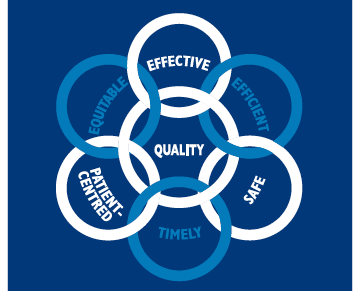
I especially like the diagram below because it goes to show that no matter how many factors or characteristics you try to implement or that a certain facility gives priority to when it comes to patient care, quality should and always will be the most important and in the center.


830d3a670e7235329886c56568612877

Sources:

  1. https://www.pinterest.com/pin/533817362054851097/ (picture)

Critical Analysis of Bundled Payments

Bundled payments have two different forms of models which are APMs and EPMs. APMs stands for alternative payment models which basically strive to improve the quality of care at lower costs for the patients. EPMs sands for episode payment models which require providers to anticipate any kind of possible risk which may occur due to any patient being readmitted into the hospital and/or any complications that may arise during a surgery.

Of course, when it comes to bundled payments, we have to look at the patient’s age and what they are at risk for based on their age in addition to diseases or problems they may have whether it is hereditary or personal.

I think bundled payments in the recent years, have had significant impacts on our lives as healthcare providers and even on the lives of our patients due to the their potential for reward. There are many different factors that affect bundled payments which can include physicians, patient care coordinators, building pathways, increasing mobility amongst patients in need, and several others as well.

In addition, I read that large employers were drowning in the high insurance costs and started to negotiate bundle pricing directly. These factors indicate that bundled payments will remain an APM or an alternative payment model. Not only that, but these types of payments can really come in handy for certain kinds of patients for example who are at high risk and need high costing procedures and operations done immediately or in a timely manner.

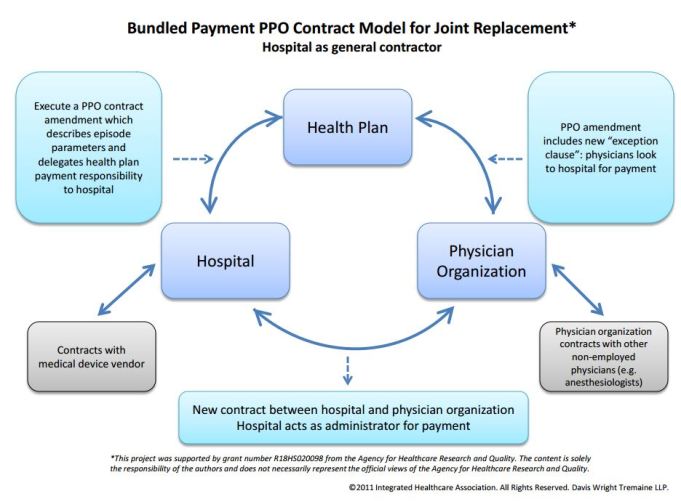
All in all, I feel that bundled payments are definitely a growing commodity that will soon become so popular that everyone will find a way to utilize it and take advantage of it’s perks. Below, is an example of a model that shows what a bundled payment looks like in case its easier to understand. This chart is just describing a general example of a bundled payment if it happened to be for a joint replacement.

Bundled_Payment_Graphic_2.JPG


Sources:

  1. https://healthpayerintelligence.com/news/top-4-factors-necessary-for-bundled-payment-model-contract (Picture)